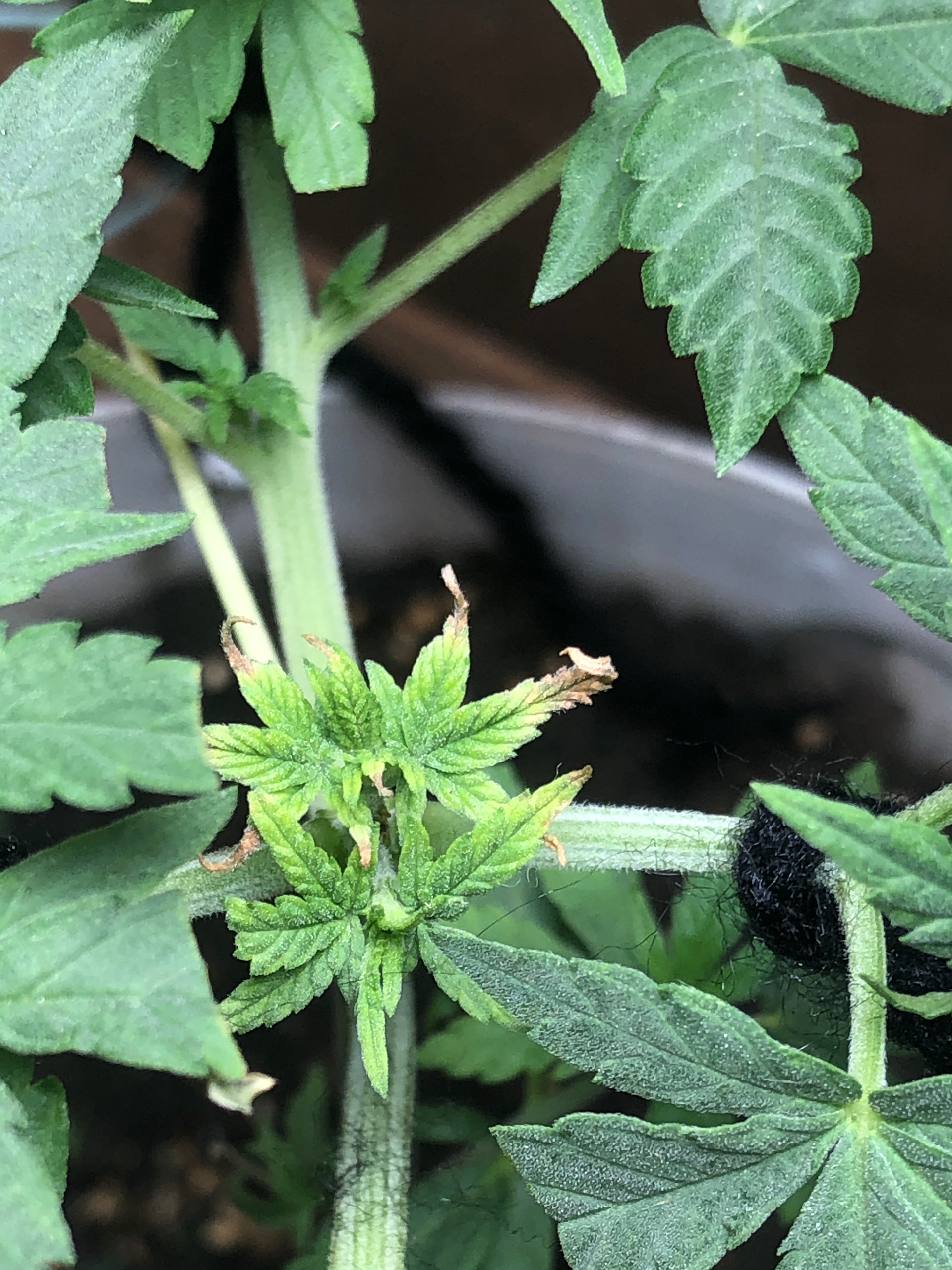
To me, it looks like calcium and boron deficiency, which are immobile, and their deficiencies appear in new shoots and new leaves (since they are immobile, if the plant no longer has reserves, the shoots are born damaged due to lack of calcium and boron, and the plant cannot send them, because they are immobile).
You should add calcium and boron in minimal doses and in chelated form via foliar application. If you don’t have purchased products with these two micronutrients, I don’t know if there’s a homemade way to produce already
If you are using LED lights, it’s almost certainly calcium; if you are using native soil, not pre-fertilized, not commercial, or of low quality, it could possibly be
I concur’ and agree 100%
How can I solve this problem, what do I give my plant?
Well, as I told you before, the immediate action is to apply chelated calcium, or chelated boron; it’s important that they are chelated, another will not work, so you should buy
if it’s impossible for you to buy it or spend money, I found with AI a way to prepare calcium citrate which is also immediately assimilable. The downside is that it needs to ferment for a week, so it’s not really convenient for you, but here you go.
Homemade Recipe: High-Absorption Soluble Calcium (WCA)
This method is inspired by Korean Natural Farming (KNF). [1]
 Ingredients and materials:
- Clean, dry egg shells (about 10 to 12 units).
- White, apple cider, or rice vinegar (with 5% acidity).
- A clean glass jar.
- A paper napkin or breathable cloth with an elastic band.
 Step by step:
- Roast the shells: Place a frying pan over medium heat (without oil) and roast the eggshell pieces for about 10-12 minutes. They should take on a slightly brown or golden color. This removes organic residues, the inner membrane, and activates calcium carbonate.
- Crush: Grind the shells in a mortar or bag until they are in very small pieces (but without making them an ultra-fine powder, to prevent them from floating too much).
- Initiate the reaction: Place the shells in the glass jar and pour in the vinegar slowly. The ideal ratio is 1 part shells to 10 parts vinegar. You will see it begin to bubble intensely; this is the acetic acid reacting to release calcium and convert it into calcium acetate.
- Resting: Do not cover the jar with its airtight lid because it could explode due to gas (CO₂) accumulation. Cover it with the paper napkin and elastic band. Let it rest in a dark, cool place for 7 to 10 days. You’ll know it’s ready when bubbles stop rising to the surface.
- Filtering: Strain the liquid with a fine cloth or coffee filter. Store the clean liquid in a closed jar; it will last for months.
A pinch of Epsom salt might also help; just dissolve it in the water you use for watering.
I think that would greatly worsen the deficiency according to the AI.