Banana cream with abnormal flowering

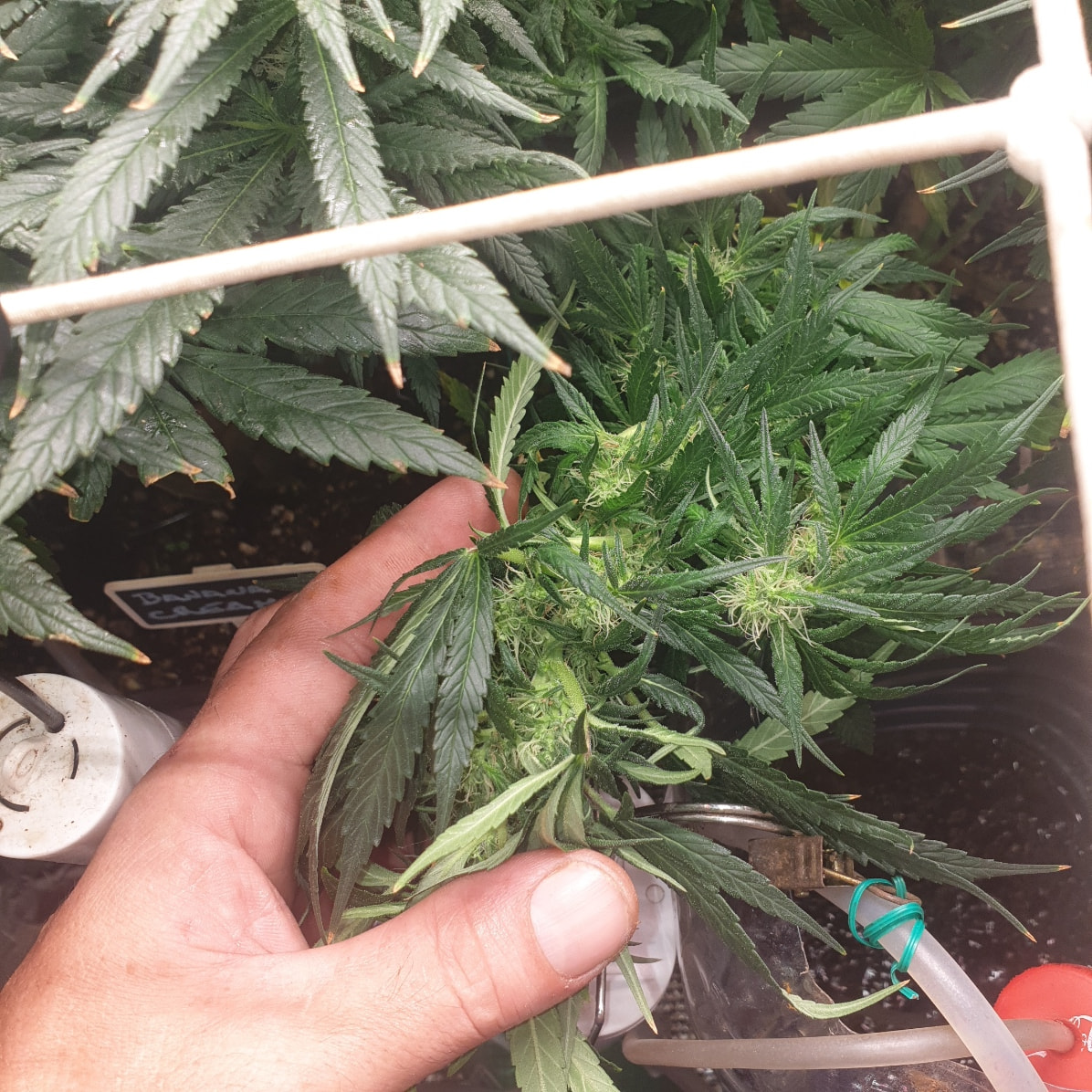
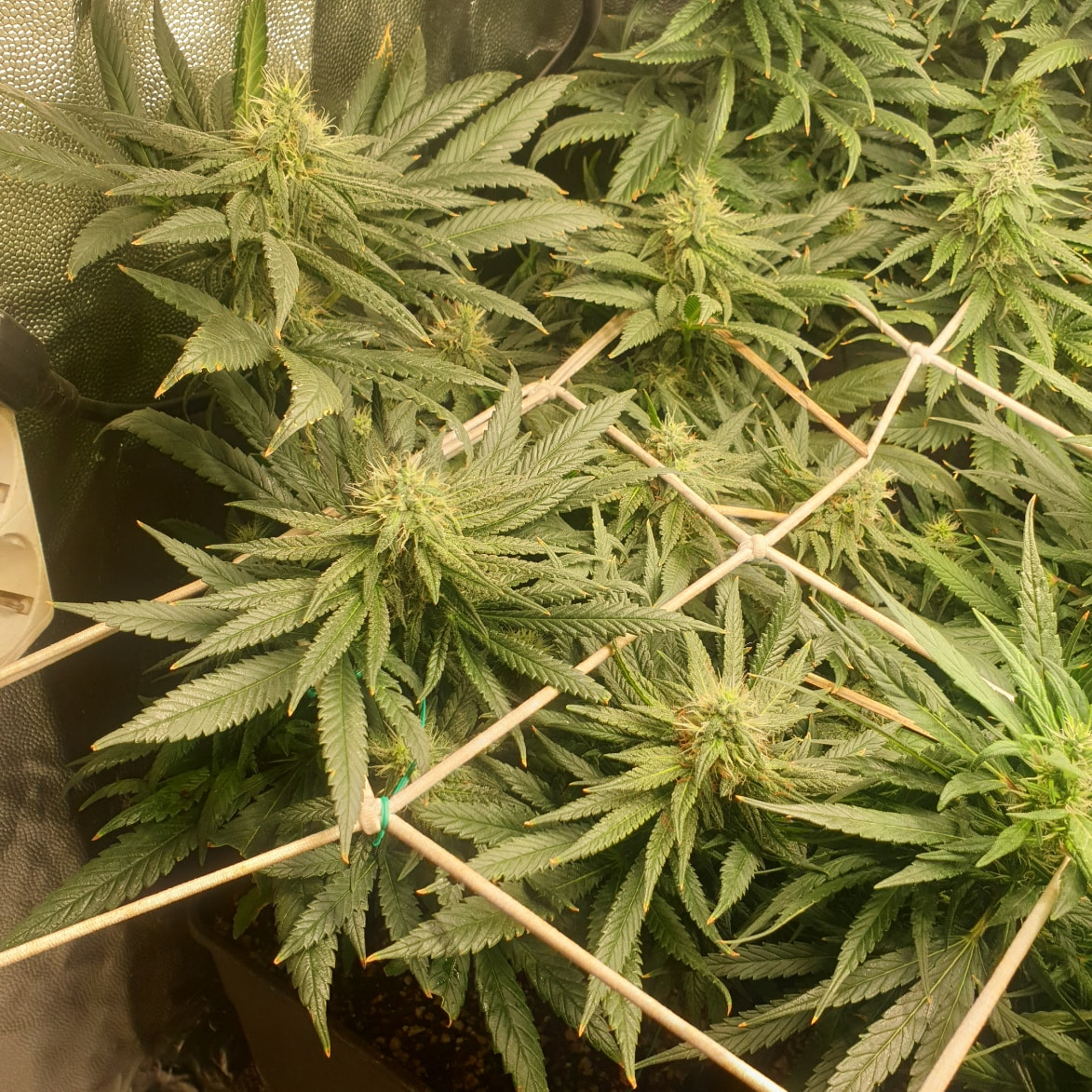
The problem is with a Banana Cream, in the grow tent there are 6 plants, the three in the back are Banana Tropicana, those are perfect.
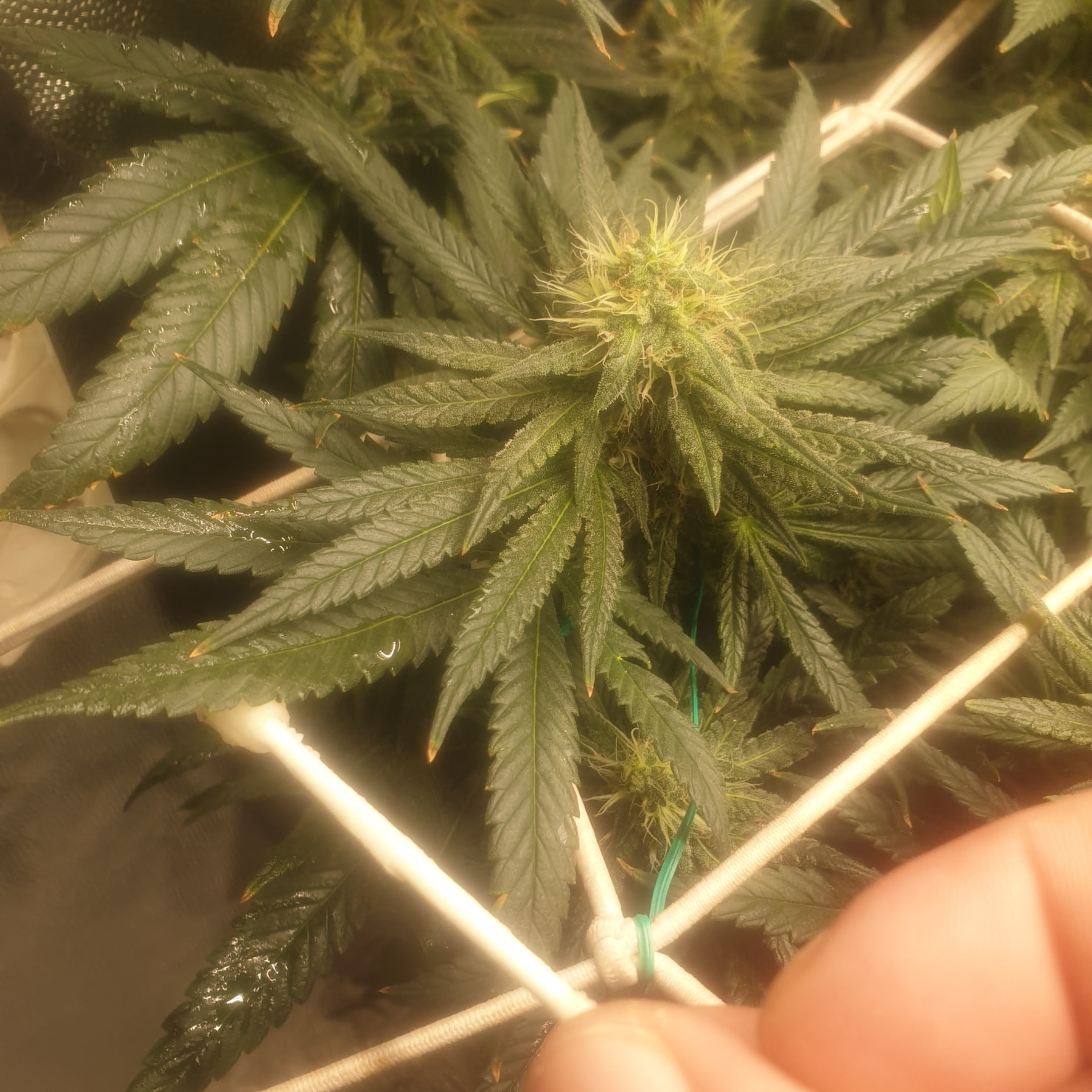
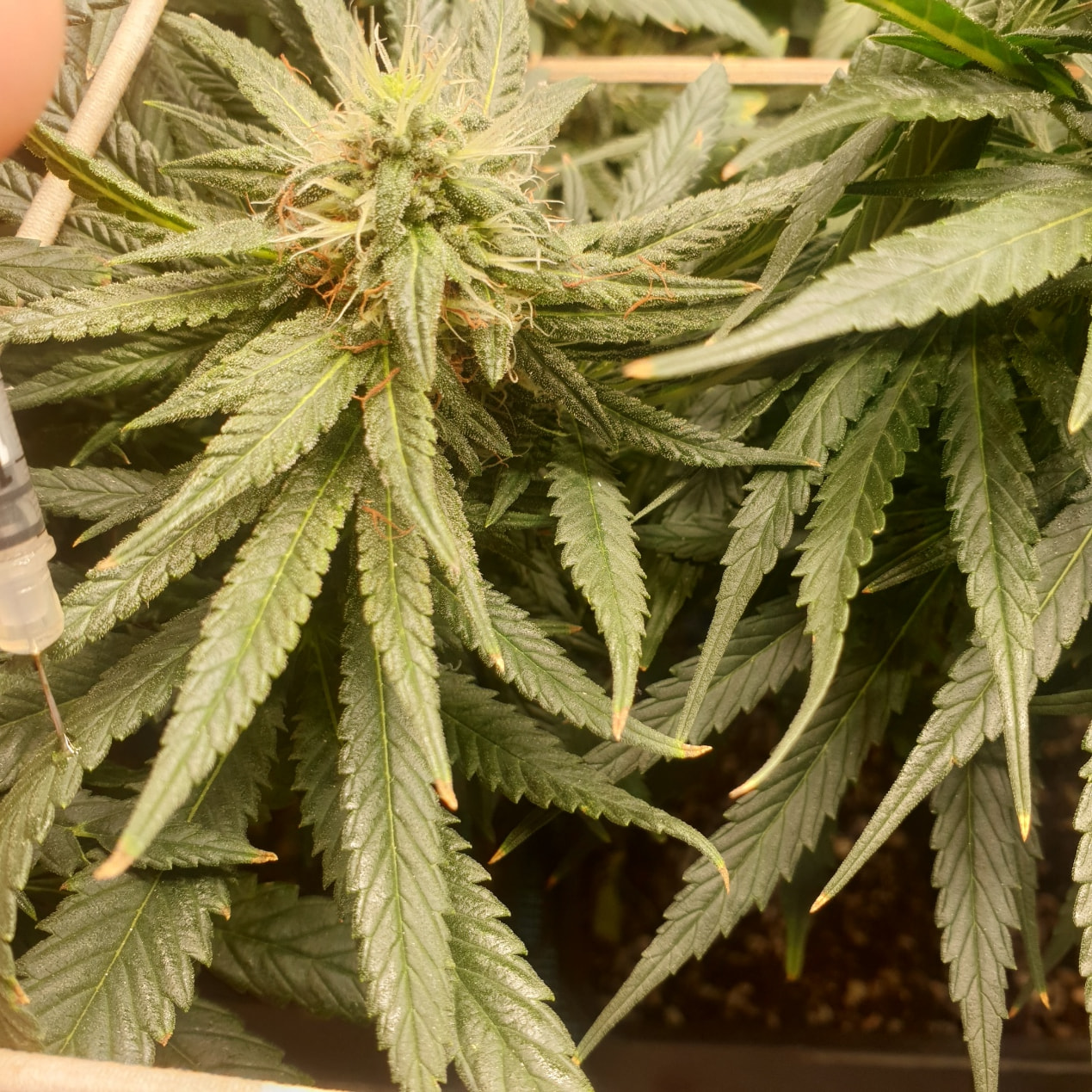
In the first three plants in the front, you can see the Banana Cream plants, the left and right ones are fine, the central one is not.
All are on day 37 since the 12/12 photoperiod change.
All received the same fertilizers during growth and flowering.
I didn’t use hormones or anything strange on any of them.
I use a long list of products: Topveg/ Cal-Mag/seaweed/humus/Silic Rock/boron/Deepunderground/ Bud Candy/ Terra Flores/ MPK during growth and flowering.
As stimulants and occasional aids I use Chitosan Oligosaccharide, Mycorrhizal Fungi, potassium soap, neem oil, acetylsalicylic acid, Triacontanol.
All products are natural.
During pre-flowering, I generated controlled stress during the first week by bending the branches, to all plants equally; all developed without problems.
This specific plant was the best during growth and pre-flowering, even when the stretch ended, this one was by far the best of the 6 plants.
Around day 24 since the photoperiod change, with pre-flowering completely finished, all suffered for 2 full days from extreme drought and a heatwave that exceeded 38ºC at the same time,
when I returned to the storage room to check the grow tent, I thought I wouldn’t recover them; the lower leaves were dead, dry and crispy, the middle leaves stuck to the stem as if melted, and the upper ones completely drooped; only the white hairs looked normal (the plant prioritized flowering).
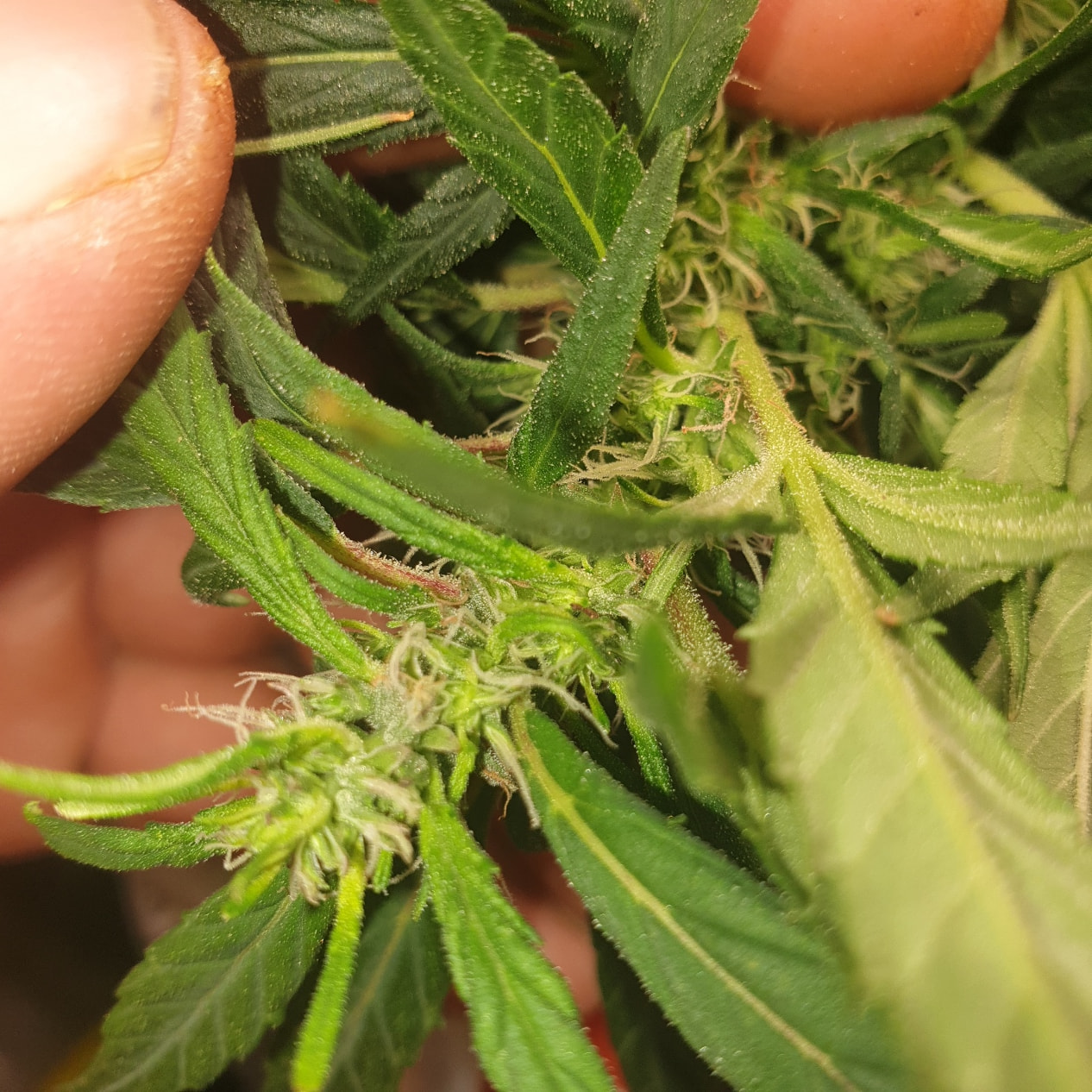
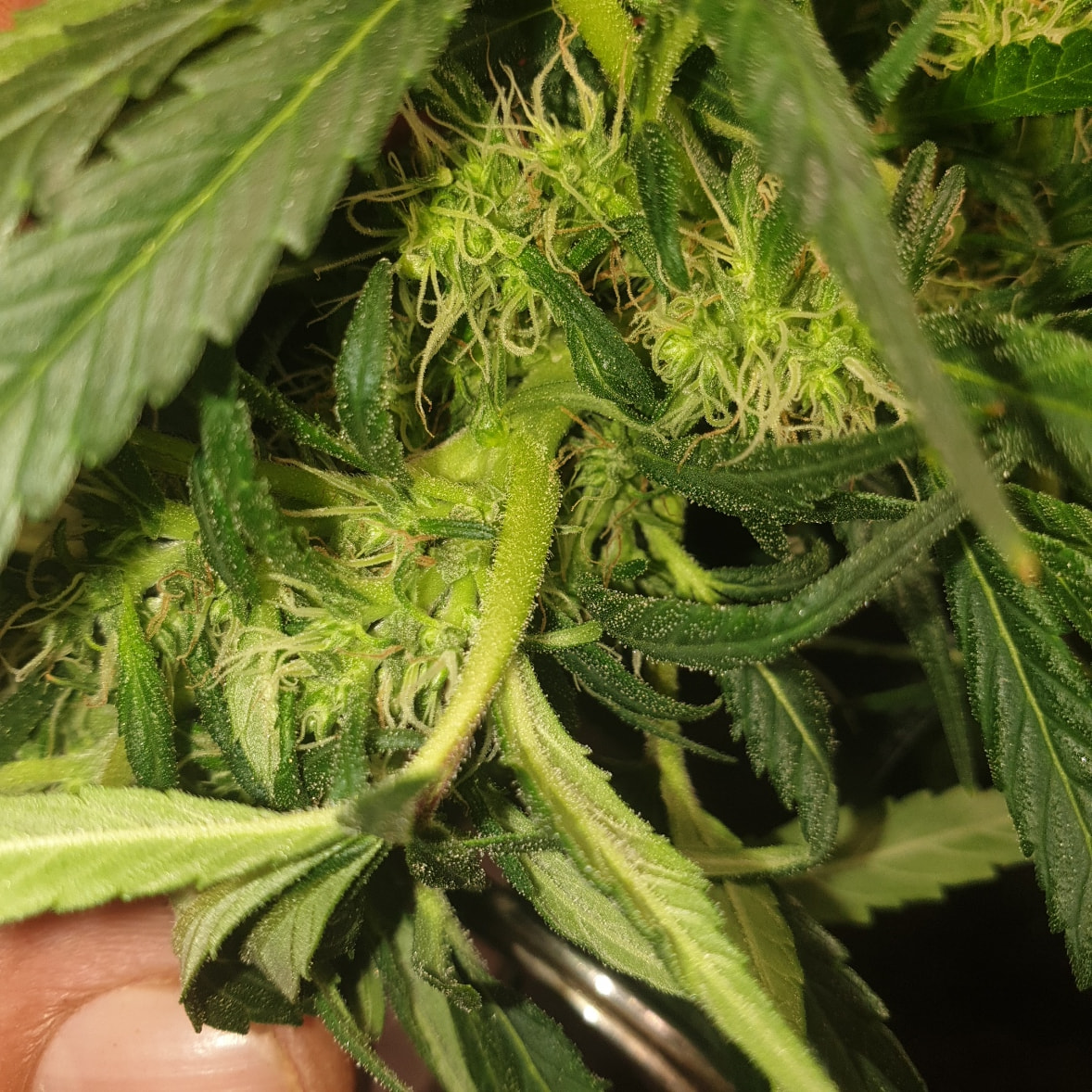
I recovered them little by little, giving small water-only waterings every 2 hours to rehydrate everything, which was a block of dry dust. After 2 hours they already looked better and all improved equally. The next day I did the same, but added a small dose of seaweed and Deepunderground. Around the 3rd or 4th day I removed all the dead parts, which I hadn’t removed to avoid generating more stress. Everything went well, except for this one; it stopped dead. If you look at the photos, the differences with its sisters are huge. I see abnormalities, like trichomes forming on the leaves, and not on the buds; nor do I see it generating calyxes, fattening the buds, or producing more hairs, nothing.
How do you see it now? It’s been the same for over 2 weeks, any ideas?


And here are the sisters


2 Likes

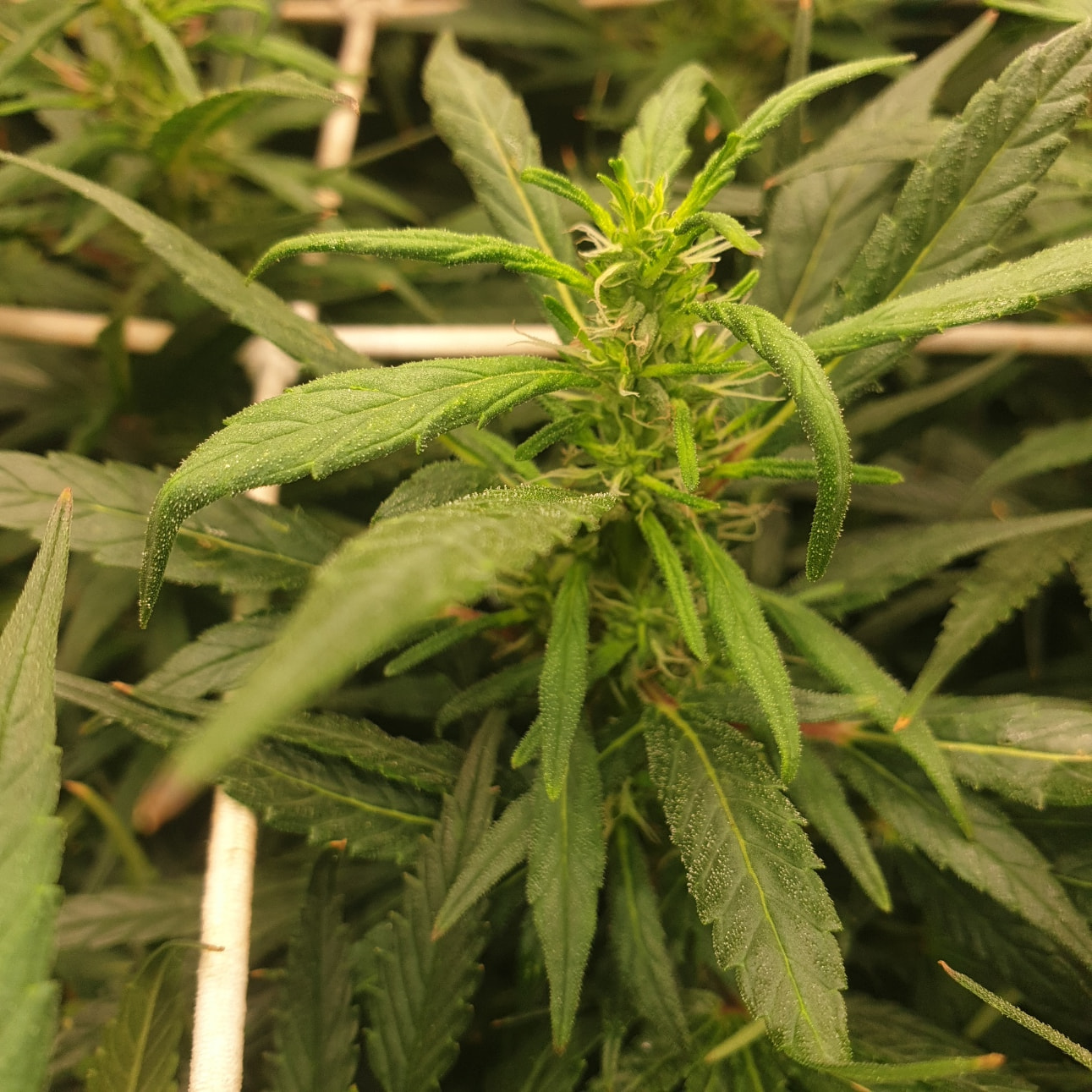
Looking closely at the images—especially image(1), image(2), and image(4)—you can actually see exactly what happened here. The plant didn’t just stop; it’s showing textbook signs of severe hormonal confusion and revegetation (re-vegging) induced by extreme shock.

​Here is the breakdown of what is happening under the hood and why this specific plant reacted this way.

​The Diagnosis: Shock-Induced Revegetation

​While a light leak or timer failure is the usual culprit for re-vegging, extreme environmental shock (like a 38C+ heatwave paired with total root dehydration right during peak early flower) can completely derail a plant’s hormonal balance.

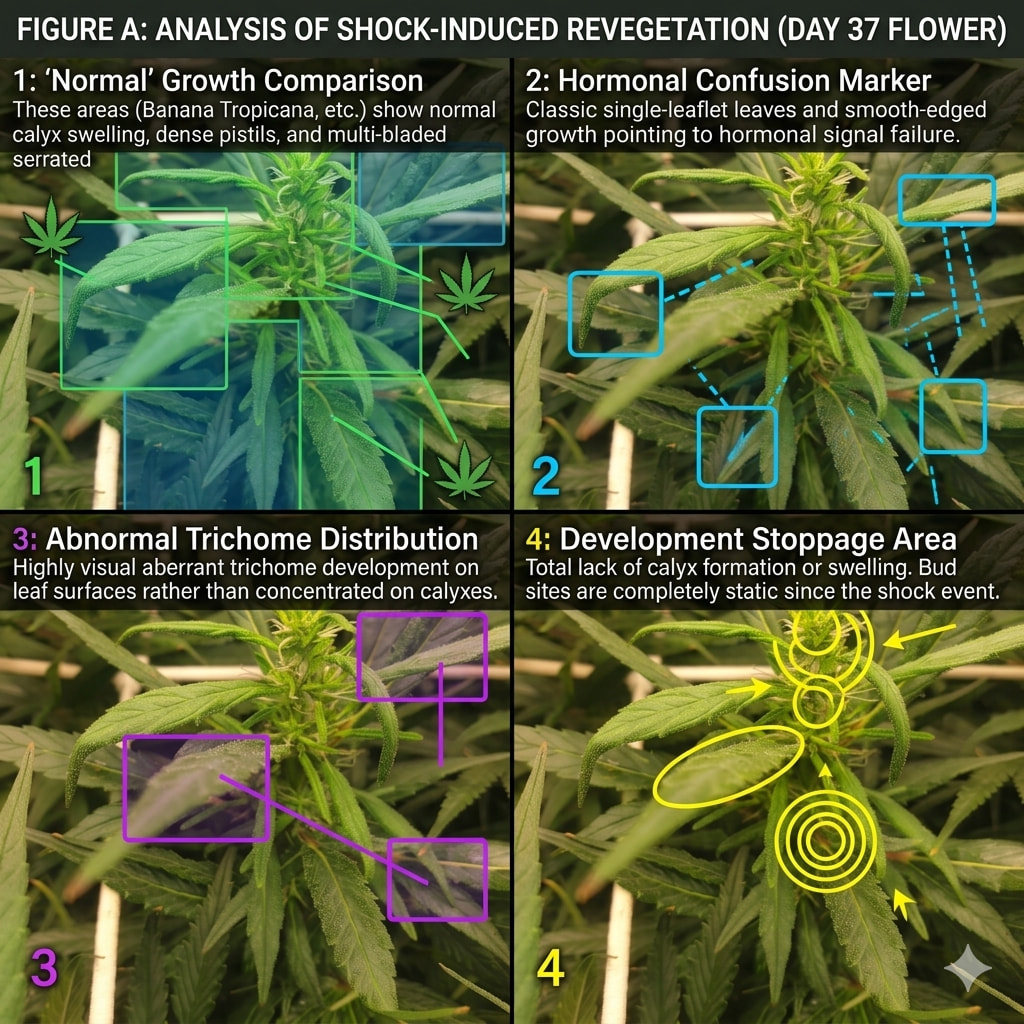
​When you look at image(4), notice the distinct structural abnormalities:

​Single-leaflet leaves: The new growth emerging around the buds is throwing smooth, single-finger leaves rather than the normal serrated cannabis fan leaves.

​Abnormal trichome placement: The plant is confusedly throwing trichomes on these single-finger leaves instead of packing them into developing calyxes.

​Stalled bud development: The pistils have stopped multiplying, and the calyxes aren’t swelling because the plant has shifted its energy away from flower production back toward vegetative survival mechanisms.

​Why only this plant?

​Because it was your best, fastest-growing plant.

​The biggest, most vigorous plant in a tent invariably has the largest root mass and the highest transpiration rate. When the water cut off and the heat spiked, this specific plant dried out its root zone the fastest, hit its wilting threshold first, and suffered the most severe internal cellular damage.

​Furthermore, you are running a very heavy, complex list of products and bio-stimulants (Triacontanol, Chitosan, Acetylsalicylic acid). Under normal conditions, these maximize potential. But when a plant hits a massive crisis, a high salt concentration in a completely dry root zone accelerates cellular osmotic shock. Triacontanol is a powerful growth hormone, and Acetylsalicylic acid triggers systemic acquired resistance (SAR)—essentially putting the plant’s internal signaling into absolute overdrive during a crisis.

​What are your options at Day 37?

​Because it has been completely stalled for over 2 weeks, you are at a crossroads. A re-vegged plant takes roughly 2 to 3 weeks just to fix its internal hormones before it can even begin reflowering properly.

​Here are your realistic paths forward:

​Option 1: The “Let it Ride” (With Adjusted Expectations)

​If you keep it, you need to treat it like a plant that is essentially back at Day 1 of flower, even though its sisters are on Day 37.

​The Reality: The final buds on this central plant will likely be airy, strange, and leafier than normal (often called “monster cropped” buds). It will finish weeks behind the others, meaning you’ll have to keep the tent running just for this one plant while harvesting the Banana Tropicana and the other Banana Creams.

​The Action: Stop using heavy stimulants or heavy PK boosters on this specific plant right now. Give it a gentle, balanced base nutrient flush to clear out any residual salt buildup from the drought, and let it slowly sort its chemistry out.

​Option 2: Cull it to Save the Canopy

​Given that space in a 6-plant tent is premium, keeping a severely stalled, re-vegged plant in the center can cause issues.

​The Reality: As the other 5 healthy plants continue to swell and finish out over the next few weeks, this central plant is going to be taking up light, root space, and humidity capacity without giving you a high-quality return.

​The Action: If you don’t want to deal with a staggered harvest or subpar yields from the center spot, it may be best to chop it. This will allow you to spread out the remaining healthy Banana Creams and Banana Tropicanas into that central light footprint, maximizing the yield of the healthy plants.

​If you have the patience and the extra space to let it finish late, you can ride it out just to see how it mutates—but if you are looking for an efficient, high-quality harvest, focusing your energy on the 5 perfect plants left is likely the winning move.

3 Likes

@Nicklovin420 wow… just… wow… friend, companion, brother, boss, I don’t know what to call you or where to begin thanking you for the detailed and extensive analysis. Plus, it looks perfect and you’ve gone to the trouble of not only giving me the complete diagnosis but also explaining it in detail, even highlighting the photos and pointing out each and every observation.
Thanks to you, I’ve just learned a lot; you’ve left me speechless, I’m immensely grateful.
To finish, I’d like to ask you if, by any chance, you know if the salty/strange aroma it currently has would be maintained if I allow it to flower, finish, and then revegetate it. In my case, the plants are just for me, and I don’t need so many; in fact, I’m starting to conduct experiments for controlled stress generation, to enhance flavors or unlock recessive genes.
As a final query, if I may, although you’ve already done so much, I wonder if by applying hormones I can help it finish its cycle in order to revegetate it, provided I can keep the new aroma it has. Just if there’s a possibility, I’d keep it alive; removing it would free up space for the others, but I’m not interested in production levels, as it’s more than enough just for me.
I have a long list of products I’ve been accumulating for years, including IBA-K, kinetin, and gibberellins.
For now, not knowing what to do or how to proceed, I will keep it alive with the hope and expectation that it retains the smell of its terpenes, but if it’s already known that after full recovery it won’t maintain it and will revert to its characteristic aroma, then I wouldn’t be interested.
I wonder, since you’ve mentioned both words, if it’s a simple revegetation or if there’s a mutation involved, and if it’s possible to preserve the terpene profile it currently has, which is bitter/dull, with no citrus, pine, or sweet notes at all, but I’m new to these experiments and don’t know much.

Again, I am immensely grateful to you; the professional and personalized analysis you’ve provided is priceless. Thank you very much, friend.

2 Likes

Absolutely. I love to help other growers! :relieved_face: And to give you the short answer first: Yes, the unique bitter/dull terpene profile you are smelling right now can absolutely be preserved, but you cannot use those pure hormones to “speed up” the flower cycle.

​Here is exactly what is happening to your plant, why it smells different right now, and how to successfully preserve it.

​Is it a Mutation or Revegetation?

​What you are looking at is not a permanent genetic mutation, nor is it standard revegetation (yet). It is a phenomenon called epigenetic stress-induced phenotypic plasticity.

​Your plant’s DNA has not changed, but the extreme heat and drought trauma permanently altered which genes are turned on or off. Think of it like a light switch panel: the trauma flipped switches that a normal, happy cannabis plant never uses.

​Why the Terpene Profile Changed

​The bitter, dull smell with zero sweetness or fruit notes is a direct result of this hormonal shift.

​Sweet, citrusy, and piney terpenes (like limonene, myrcene, and pinene) are highly volatile. When the tent hit 38°C+, those light, sweet aromatic compounds literally boiled off into the air.

​In response, the plant spiked its defense terpene production. Heavy stress can lead to an accumulation of heavier, bitter compounds (like caryophyllene or specific sesquiterpenes) that act as natural insect repellents and sunscreens.

​Will it stay? If you try to force this plant to finish flowering, the unique smell might change as the plant tries to senesce (age). However, if you take cuttings or revegetate it now, those exact environmental switches can remain locked in, allowing you to keep this unique bitter profile in a mother plant.

​The Danger of Using IBA-K, Kinetin, and Gibberellins Right Now

​It is incredibly tempting to use that chemist’s toolkit you have accumulated, but applying pure hormones to an already hormonally scrambled, flowering plant is highly likely to kill the tissue or turn it into a complete hermaphrodite.

​Gibberellins (GA3): Do not use this right now. Gibberellins signal elongation and trigger male flowering. Applying GA3 to a flowering female cannabis plant under severe stress will cause it to instantly grow male “nanas” (pollen sacks) and hermie completely, ruining your chance to save clean genetics.

​Kinetin (Cytokinin): Kinetin promotes cell division and lateral shoot growth. While it is used in revegetation, applying it while the plant is still under a 12/12 light cycle will further confuse the plant’s internal signaling, keeping it locked in its frozen state.

​IBA-K (Auxin): This is a water-soluble rooting hormone. It is fantastic for making clones strike roots, but applying it to the canopy or root zone of a flowering plant in stasis will not force it to finish its cycle.

​How to Proceed: The Best Strategy to Save the Terpene Profile

​If you do not care about the harvest weight and just want to save this specific, unique bitter expression, stop trying to make it finish flowering. Because it has been frozen for over 2 weeks, forcing it to finish a normal cycle will be an uphill battle, and the terpene profile will likely degrade as the old flower tissue dies.

​Instead, your best path forward is to flip it directly into Revegetation (Monster Cropping) right now to save it as a mother plant.

#1

Flip the Lights to 24/0 or 20/4

Day 1

Immediately move this specific plant out of the flower tent (or change the schedule if you are willing to sacrifice the others, though it’s better to isolate it). Put it under a constant vegetative light cycle using a gentle, soft light (like a lower-wattage LED or T5).

#2

Prune the Top Buds Gently

Day 1

Cut off the main, frozen top buds. Leave the lower, smaller bud sites and as many green leaves as possible. The hormone auxin is concentrated in the top tips; removing them breaks the plant’s desire to flower and forces it to look to its lower nodes for new vegetative growth.

#3

Flush and Feed a Pure Veg Diet

Day 1

Flush the media with plain water to clear out any flowering fertilizers (MPK, Terra Flores, Bud Candy). Then, give it a very light feed of Topveg and Cal-Mag. You want high nitrogen to signal to the plant that it is time to grow leaves and stems again, not flowers.

#4

Wait for 2-3 Weeks

Within 14 to 21 days, you will see highly distorted, single-finger, non-serrated leaves growing straight out of the old bud sites. This is normal! It means the revegetation is working.

Once the plant stabilizes and starts growing normal, 3-finger and 5-finger serrated leaves again, you can take fresh clones from it. Those clones will carry the exact epigenetic blueprint of this stressed mother. When you grow those clones out under normal conditions, you will find out if that bitter, heavy terpene profile stays locked in as a unique new keeper for your personal headstash. How this helped

:grin::+1:

3 Likes

Man, your explanations are really incredibly detailed. You don’t happen to work as a professional grower, do you?

2 Likes

Haha, no, not a professional! Just a hobbyist who is very obsessed with the details and loves the science behind it :rofl:But i take that as a huge compliment, thanks!

3 Likes

I had also looked at the pictures and immediately thought of revegging because of the single-blade new growth. However, I wasn’t sure since it’s 12 hours light/dark. Stress was also in the back of my mind as a suspect. But I didn’t want to draw wrong conclusions and give bad advice. But what you put out there is very professional. Hence the thought of a pro.

2 Likes

Thanks a lot, friend, today I’m going to move it to the growth cabinet, tomorrow I’ll do the root flush and bud pruning since watering isn’t due yet. I hope to be lucky enough that the

3 Likes