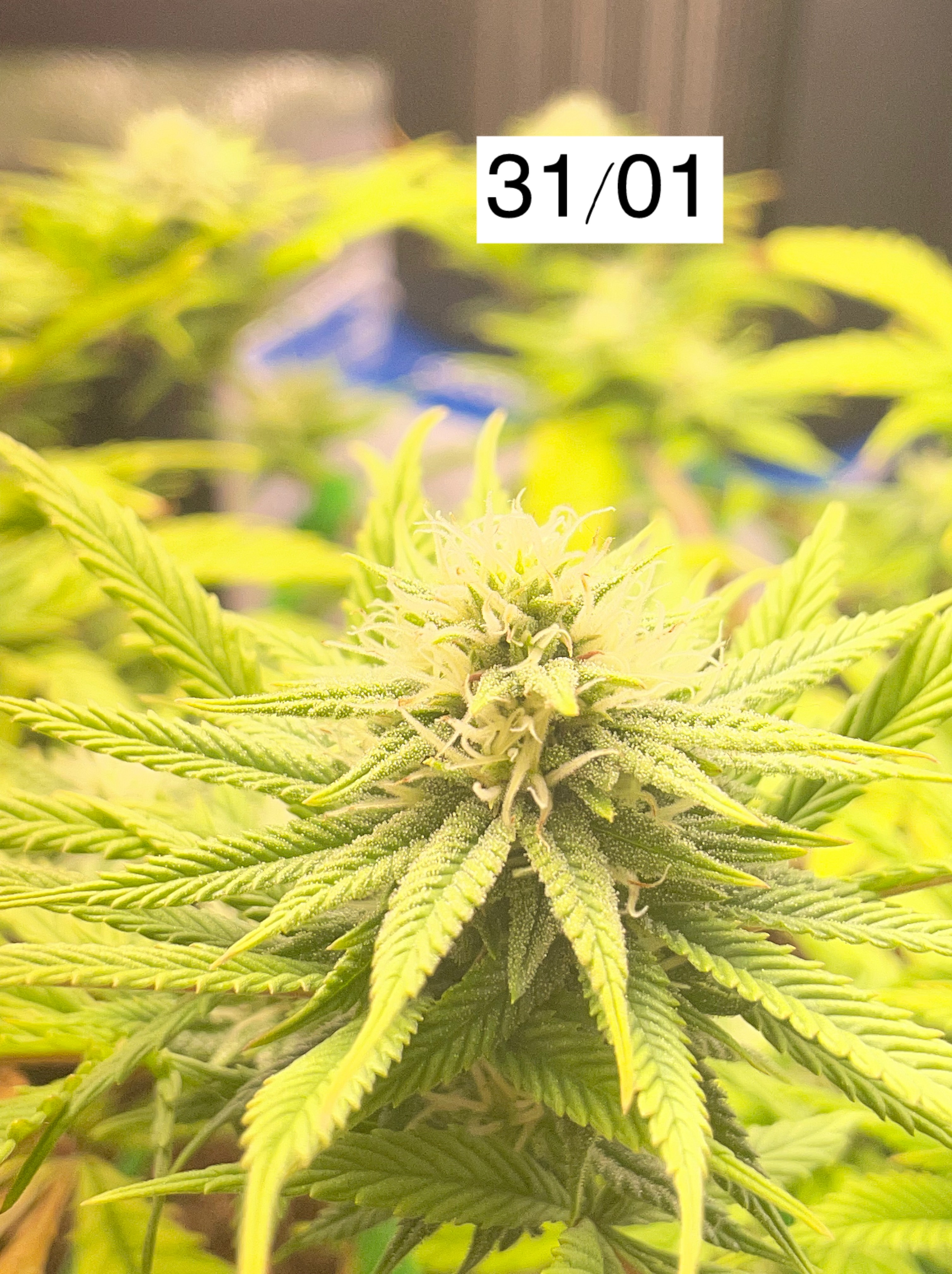
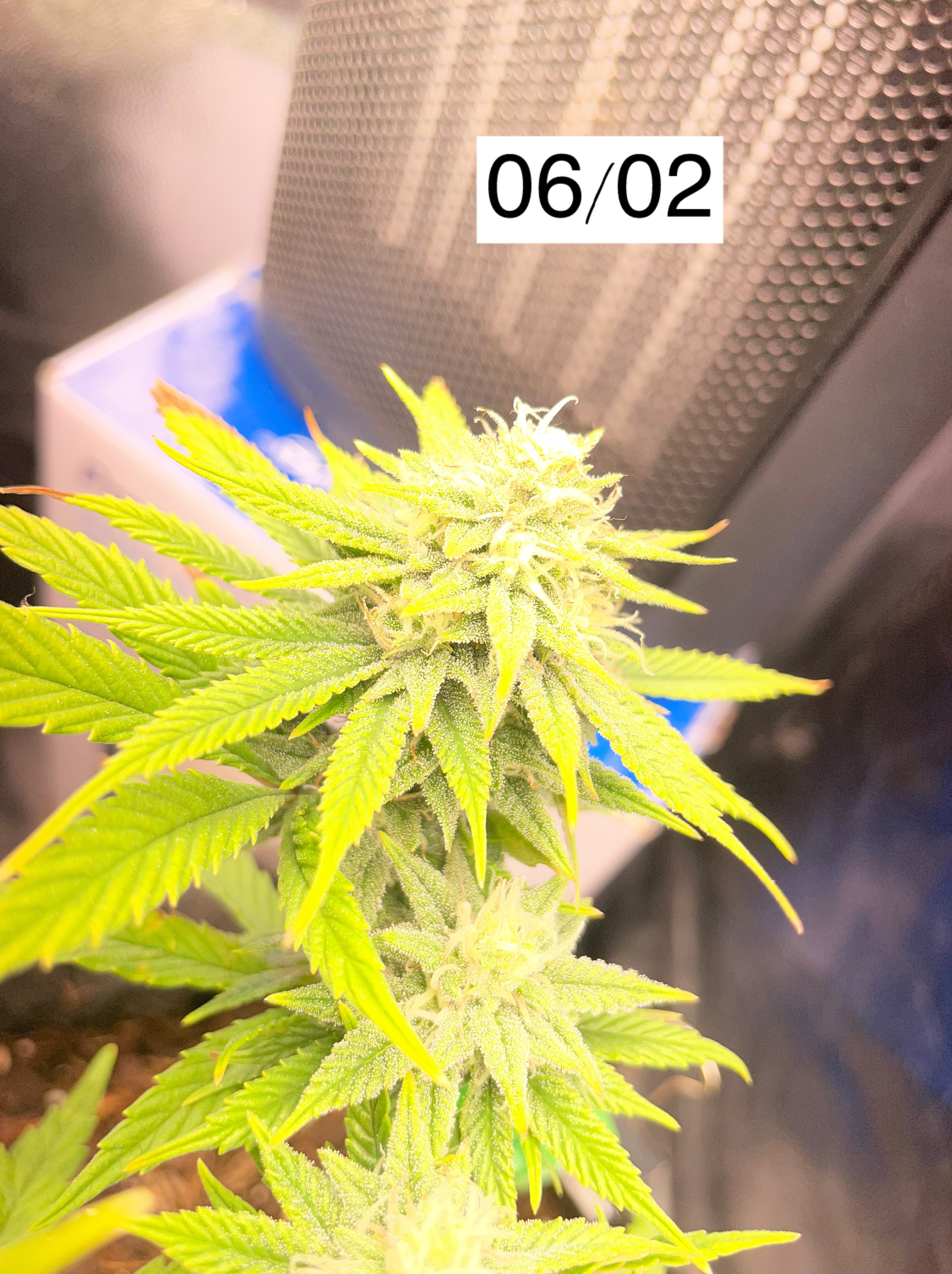
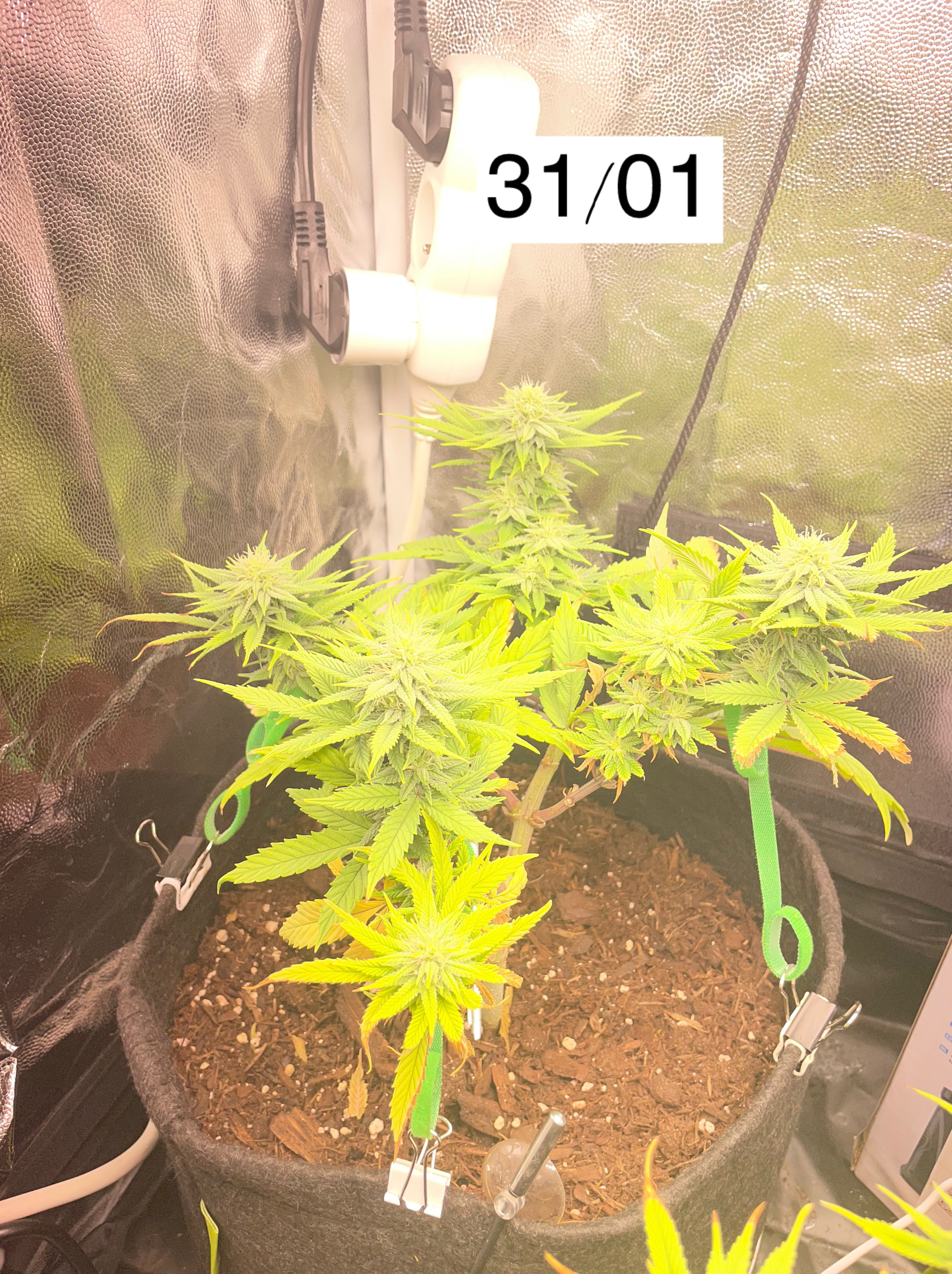
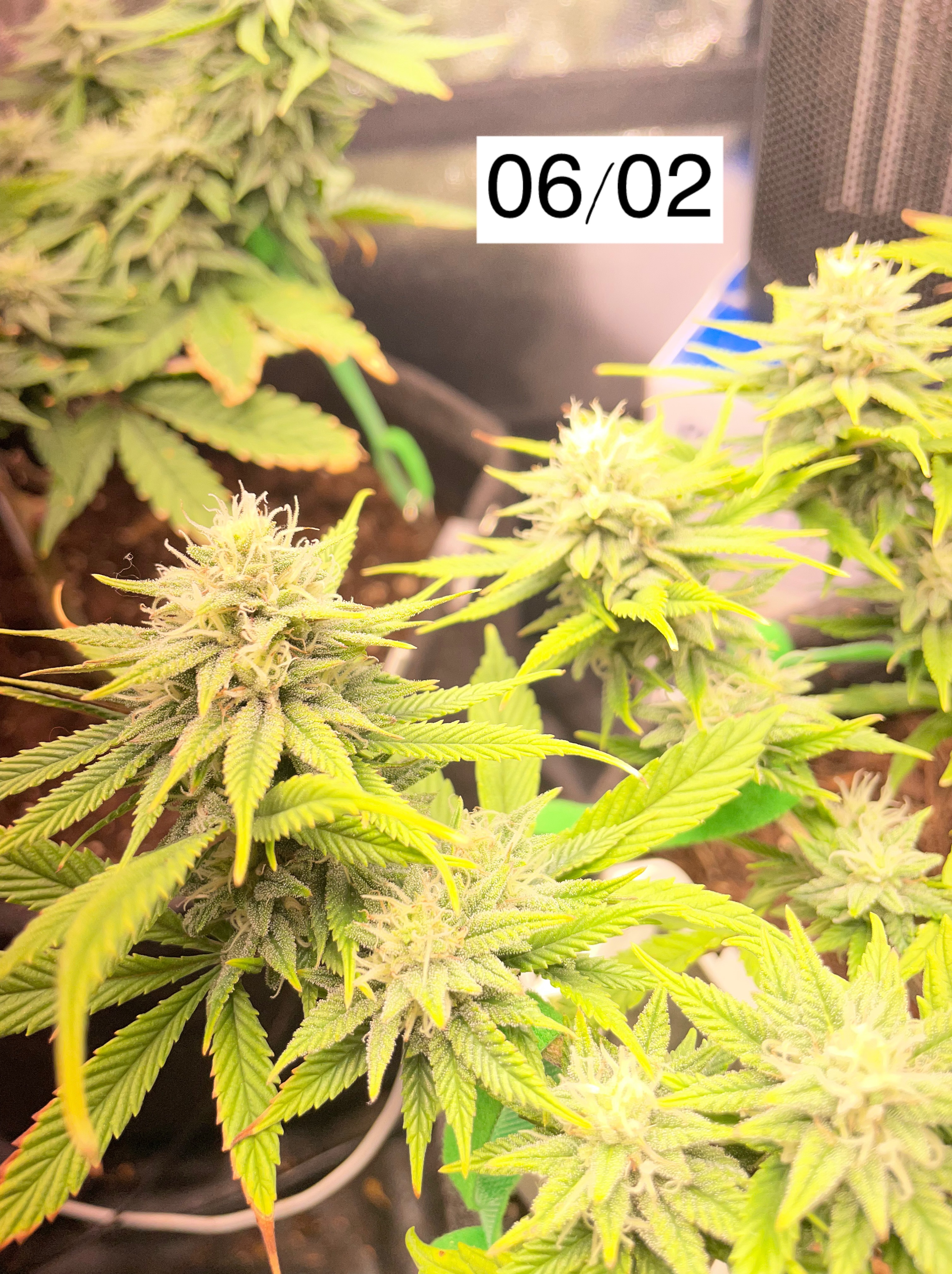
Here are my two super skunk babies, they’re about 10in tall and have been flowering since Jan 04 (so today is day 34 (week 5) of flowering).
Some pistils appear to be starting to brown a bit (but I can’t for the life of me manage to use the microscope I bought to check the trichomes) and the buds are getting dense and firm. I’m wondering how long it will take for them to reach harvest time?
I ask because I want to know when to start flushing them by giving pure water, which is supposed to happen the “last few weeks” (I’m guessing two?)… but when will that be?
Flushing is bro science, you don’t HAVE to do it. It does help save on nutes so there is that benefit. The dark period and ice water are also bro science. There is no proof it does anything in any way. As for chopping the whole plant and hanging upside down, I’d say do the whole dry that way and dry trim after 12-18 days of 60/60. Sorry for being so short and to the point, I’m responding while making dinner for the family.
What @BluntForceTrauma420 is referring to with 60/60 is 60% relative humidity and 60°f temperature. That is what most people aim for when it comes to drying conditions. Hanging the whole plant in conditions like that gives you a good slow drying process which helps to preserve everything nicely.
As for the flushing part, i only do it if i would have to buy more nutrients to finish the run otherwise. It’s a money saving thing for me and I have never seen any difference between flushing and not. Sometimes cutting off the food can work against you when it comes to final numbers. Do you work as hard when you are hungry? My take on the dark period is the same, trichomes are made partly as sunscreen for the plant, taking away the light removes the need to produce more of them especially when light energy has also been taken away.
With mineral fertilizers, flushing should be done 14 days before harvest. With organic fertilizers, it is not important to flush, as this only feeds the soil life that nourishes the plant.
Before harvesting
Regardless of organic or chem salts, flushing is 100% bro science in my opinion. Why would you need to flush mineral salts and not organics? Chemical salt fertilizer is not “synthetic” as we so often say, it is the same chemicals the “organic” elements break down to for plant use.
Also, you can’t “flush” anything from the actual plant itself, you can wash the soil/medium and strip it of nutrients, but what the plant has taken in prior to the flush is still there after the flush.
Personally I think a good dry and cure after harvest will solve more issues than starving them at the end.
Late flower feed vs flush, I say feed till you want them to stop growing. If you have to do a flush, wait until the last few days, you’ll notice the plant pretty much stops feeding . . . that is the plant telling you she’s had enough, time to rinse your medium if you think it will help.
I thought flushing was to force the plant to use up everything in the ground and in itself from the leaves and stem to put it in the buds so in that regard it seemed to make sense. Also I understood it meant the chemical buildup in the buds would be reduced by the fact that the “pure water” now circulating in the plant “diluted” the potential accumulations.
I’m ok with not doing a flush if it doesn’t at least bring that advantage, as I’m not looking for a boost of production or potency, but more so to have a “cleaner” taste.
You’re correct in that being the goal, but I think that as long as they are hungry enough to cannibalize themselves they’re still growing and need to be fed . . . by adjusting the nutrient ratios and controlling EC throughout flowering you can continue to feed without buildup issues. Just don’t feed them anything they don’t need . . . more difficult to accurately manage in soil/organics in my opinion.
If it only takes what it needs, why do plants grown in soil, using organic methods have a much higher chance of showing cadmium and lead contamination than those grown in a controlled soilless/hydroponic method?
If organic methods provide all the needed nutrients, at the right ratios, at the right stages of the plants life as accurately as a well managed soilless/hydro grow, why do they generally yield less?
As for testing higher on those levels it depends on the inputs and the soil used.
As for yield in hydro you force feed the plant with nutrients that are bonded to water molecules. So every time the plant wants to hydrate it’s also fed. Organics the plant decides what it needs so it grows as it genetics want to grow. The difference between the 2 when executed flawlessly is not that much but still worth the discussion.
The part that I question in the whole force feeding of synthetics is this. If the plant is actually taking all the nutrients that you are putting into the water why is there such a build up of nutrients and minerals in the medium? If it truly has no choice in what it takes in there should theoretically be nothing left behind to cause a build up in the first place regardless of feeding type. I have never found anything to answer that one in a way that makes any sense to me.
Hydroponics doesn’t really force feed . . . it just makes the nutrients more easily available in a usable form.
Nutrients being bonded to the water molecules is true regardless, in soilless or hydro that bonding is done prefeed, in organics it occurs when you water.
Think about it, in organics you pour water through charged soil and it transports nutrients to the root system . . . in hydro we mix it before feeding to control nutrient ratios and EC more accurately.
I think it would be that we never allow the plant to fully consume the provided nutrients before we feed again in order to maintain a minimum EC level for good growth. Unless you are running a medium that is suited to flushing with every feed, or you can adjust nutrient ratios and EC to closely match what is being consumed you’ll likely see buildups.