Hi, everyone,
I’ve seen on gardening that a good way to strengthen the plant and help her produce is to prune the old roots away and replant on a clean pot with nice organic substrate. This is used in situations where the medium/substrate stops having enough nutrients for the plant.
Is there any benefit to do this on a cannabis plant before it entering flowering stage? Would it be preferable to use good bacteria and fungi to eat the dead roots?
HOW TO INCREASE MARIJUANA YIELDS WITH ROOT PRUNING

WHAT IS CANNABIS ROOT PRUNING?

With root pruning, you can prevent plants from ending up with tangled roots, thus increasing their health and productive potential. Root pruning is especially important if you are growing mother plants , as sooner or later they will end up with knotted roots. But root pruning is also beneficial for cannabis plants grown for a single season.
The reason for this is that potted plants are limited to the volume of the pot. Therefore, when the roots end up tangled, normally the next step would be to transplant the plant to a larger pot .
But transplanting into a larger pot is not always optimal or possible. This process stresses the plants, and not everyone has enough space to constantly increase the size of the pots. And in the case of large mother plants, continually moving them into a larger pot is not a viable solution; there would come a time when you would need a giant pot. This is not only impractical; In addition, thanks to root pruning, it is totally unnecessary.
There are two ways to prune the roots: hand pruning and aerial pruning. Let’s see the differences between the two.
AERIAL PRUNING VS MANUAL PRUNING

Unlike manual pruning, where you cut the roots using a blade, aerial pruning is done automatically. When the roots come into contact with air, which is when they reach the edge of a permeable pot, the roots naturally prune and develop a double tip.
The new root tips will push through the soil until they reach the edge of the pot again. Compared to plants grown in normal (closed) pots, the roots will continuously grow sideways (not circling), pruning themselves many times. As a result of aerial pruning, the root mass will increase considerably - up to 5 times more than in an ordinary pot.
WHAT CONTAINERS ARE BEST FOR AERIAL PRUNING?
Aerial pruning relies on the roots being exposed to fresh air at some point. The best pots for this are usually made of a soft and permeable fabric, which allows the passage of water and air. Fabric pots or grow bags, also called “smart - pots”, are generally made of a porous geotextile material. You can also use simple cloth pots made of felt, if you dare to make your own pots.

(219)
Fabric pots are great for aerial root pruning, but they are not always optimal. Large fabric pots often lack stability and structure, which can be a problem especially for indoor growers. This is where air-pots come in.
Air-pots work just like the aforementioned fabric pots, except they’re made of plastic and have holes in the sides. They are stronger and more robust than cloth “bags”, but are usually more expensive as well.
Alternatively, you can also drill holes or slits in the sides of a regular pot to create the desired airflow.
ADVANTAGES OF PRUNING MARIJUANA ROOTS

After explaining the basics of root pruning, let’s look at why you might want to use this method. Here are some advantages of pruning the roots:
- Healthier and stronger plants: the root system of plants with pruned roots is up to 500% denser than that of plants grown in normal pots. This means that plants can absorb more nutrients and oxygen, improving their development.
- Higher yields : By being able to absorb more nutrients and oxygen, the plants will be larger and more vigorous, producing higher yields.
- It is not necessary to transplant marijuana to larger pots: with root pruning, whether manual or aerial, the roots will not exceed the pot so they will not grow tangled. So you won’t need to transplant them!
WHY IT IS ESSENTIAL TO PRUNE THE ROOTS OF MOTHER PLANTS

Marijuana is an annual plant, which means that nature has not designed this plant for you to keep for a long period of time. If we want to keep a mother plant in the growth phase, we will have to cheat a bit so that it is healthy and provides us with quality cuttings . To do this, we can prune the roots, which is essential for mother plants.
When grown in ordinary pots, the plants will soon reach a size limit determined by the volume of the pot and the available substrate. If the plants grow too long in the same pot, the roots will suffocate, and also the soil will compact and mineral layers will form on the surface. The poor structure of the substrate will make it difficult for water to penetrate, which will cause dry areas in the soil and make it difficult for water to absorb. As a consequence, the health of the mother plant will gradually deteriorate, and the quality of the cuttings will also be reduced.
But this can be avoided thanks to root pruning. Every time you prune the roots of a mother plant, you are renewing the root system of the plant, as well as adding a fresh substrate. Your mother plant will always be happy!
On the other hand, certain cannabis strains, such as some Hazes, are especially sensitive to stress caused by root entanglement. This can even cause the plants to start flowering; and that is not exactly what you want to happen with your beloved mother plant.
WHEN TO HAND PRUNE CANNABIS ROOTS

How can you know if you should prune the roots of your marijuana? There are some signs to watch out for:
- Roots coming out of the holes in the pot: If you see roots coming out of the holes in the bottom of the pot, it is very likely that your plant has root knots. It’s time to prune the roots!
- The branches and stems become hard, woody and less flexible: this is known as lignification, a function of plants in which they strengthen their structure in response to stress. But it also indicates that the plant has reached the limit of the pot and urgently needs root pruning.
- Stunted growth and poor plant health – If your plant is not growing well, especially if it has been in a small pot for a while, it has probably outgrown the pot. Pruning the roots will revive the plant and give it vigour.
TOOLS AND GUIDELINES FOR PRUNING CANNABIS ROOTS

To manually prune cannabis roots you will need several tools. It is important to keep the work area and the tools very clean and sterilized. Freshly cut cannabis roots are highly sensitive to harmful microorganisms.
TOOLS
- Small scissors ( bonsai pruning shears are ideal , but nail clippers will also work)
- A large knife (if you are pruning potted plants)
- Tweezers (to access the small parts of the roots)
- Isopropyl alcohol and kitchen paper (to sterilize the tools)

(70)
ROOT PRUNING GUIDELINES
- Do not prune mother plants just before or after taking cuttings. Cutting the cuttings puts a lot of stress on the mother plant; therefore, allow it to recover for 3-4 weeks before pruning the roots.
- Following on from the previous point, when you prune the roots of a mother plant, wait at least 3-4 weeks before taking cuttings.
- Do not prune the roots during flowering! Pruning the roots of a flowering plant will greatly reduce the yield. You should stop pruning the roots within two weeks of the start of flowering.
- Do not prune the roots of a sick or stressed plant. This includes pest infestations, nutritional problems, extreme temperatures, etc. Wait until the plant is healthy and conditions are optimal before sticking the knife into the roots.
- Prune no more than about a third of the total root mass. Less is more! If you cut too much, the resulting problems (stress, required recovery time, etc.) could outweigh the benefits.
- Prune only a few inches from the outside of the root mass. Prune all sides evenly, to achieve a symmetrical root ball (the mass of soil and roots).
- Keep tools clean and sterilized. Use alcohol and kitchen paper, and clean the tools between each cut.
- “Normal” cannabis plants should not be pruned more than once in a growing season. By “normal” we mean the plants you will harvest at the end of the season. Mother plants should not be pruned more than three times a year.
HOW TO MANUALLY PRUNE THE ROOTS OF MARIJUANA PLANTS
Let’s take a look at the best way to prune cannabis roots when growing in soil or hydroponically.
HOW TO PRUNE ROOTS IN GROUND CROPS

Preparations
-
- Before you start with the roots, you must prune the foliage of the plant. The idea is to greatly reduce the leaf mass, by pruning the plant back to about two-thirds of its initial height. This reduction in the number of leaves will help the plant conserve water and nutrients so that it can focus its energy on growing new roots. This foliar pruning will also allow more light to reach the lower parts of the plant, favoring the development of new shoots.
-
- After pruning the foliage, allow the plant to recover for a week.
Reduce Root Ball And Add New Soil
Now we can get down to work with root pruning. To reduce stress on the plant, make sure the soil is not too dry/wet.
- Remove the root ball from the pot, carefully sliding it out. Place the root ball on the edge of a table, as this will help you a lot when cutting.
- Take a large, sterilized knife, and make a clean cut about 2-3cm from the bottom of the root ball. Next, cut and remove 2-3cm from each side of the root ball. The exact size of the “root slices” you should cut depends on the overall size of the root ball. Basically, you want to remove about a third of the total mass of roots. On the internet you will find tutorials of people who cut much more, leaving only a small cube of the initial root ball. We recommend following our method and leaving a bit more.
- Once you have cut the bottom and sides of the root ball, the plant is ready to be transplanted into the new substrate. At this point, consider whether you should change the pot for a larger one. For example, if your plant was in a 2 gallon pot, move it to a 25 gallon one. To facilitate drainage, add a 2-3cm layer of perlite or clay pebbles to the bottom of the new pot.
- Place the root-pruned plant in the new pot and fill the sides with fresh soil. Lightly press down on the substrate to compact it a bit, but not too much.
- Water the newly transplanted plant. This is a great opportunity to use a root booster! After a few days, the plant will begin to develop new, healthy shoots.

(eleven)
HOW TO PRUNE ROOTS IN HYDROPONICS

If you grow hydroponically (either DWC, NFT, or aeroponics), you’ll find that these systems encourage the development of especially large, white root masses, which can quickly outgrow any pot. But do not worry! Root pruning also works in hydroponics. In fact, it is an easier and cleaner process compared to pruning the roots of plants in the ground.
- Inspect the roots to see if they need pruning. One of the advantages of growing hydroponically is that plants can produce good results even with much smaller root systems. To tell if the roots need pruning, you should occasionally look “under the hood” of your hydroponic system. You’ll want to cut any roots that are longer than the others so that they are all the same length, more or less.
- Remove the pots. When doing this, be especially careful that dirt does not get into the hydroponic system. Remember that recently cut roots are very sensitive to contamination; don’t let bacteria, mold or fungus make your plants sick.
- Sterilize the bonsai pruning shears. Cut any roots that are too long, making clean cuts. The goal is to have an evenly shaped root ball that fits well in the pot.
- Do not cut the neck of the root! (also called root crown, where all the roots come together in the center). When you start cutting the roots of your hydroponic plants, it’s easy to get carried away. You may want to cut off any discolored, slimy, or dry parts. But don’t get too close to the root collar, as you could damage it. Just like trimming the roots of plants in soil, it’s better to cut less, and it’s safer for hydroponic plants. Cut only the overly long parts, and remove just a few inches from the bottom and sides to get an even root ball. Keep the knife away from the area where the stem meets the roots.
- Put the plants back in their pots. Just like when you took out the plants, make sure that no dirt of any kind enters the system.
WHAT CAN YOU DO WITH PRUNED CANNABIS ROOTS?

When you’re done root pruning, you’ll probably end up with a handful or two of freshly cut roots. But they can still be used! Like other organic matter, such as leaves or wood chips, roots are a good soil improver. They are the favorite food of all kinds of soil microorganisms, which will convert them into available nutrients for plants.
[
Related article
How And Why To Use Cannabis Roots
](Cómo Y Por Qué Usar Las Raíces Del Cannabis - Zamnesia)
The cut roots can also be mixed with poor potting soil, thus improving its texture and drainage. Another option to put the roots to good use is to add them to the compost bin.
AFTERCARE AFTER ROOT PRUNING OF MARIJUANA PLANTS
Root pruning can cause a lot of stress to marijuana. To help your plants recover, you can use certain additives like a root stimulant. Root stimulants not only promote the development of new roots, but also contain ingredients that strengthen the resistance of plants during periods of vulnerability.
A vitamin B complex (consisting of folic acid and vitamins B5 and B1) is also beneficial for root development, as well as supporting plant immunity and resistance. Finally, potassium silicate is another good supplement for root pruning aftercare, as it fights pathogens while protecting and strengthening plants.
1 Like
Amazing material, thanks!
1 Like
I have broken up the rootball before transplant. But never cutting them. If you try it, let us know. Thanks for sharing
Can I suggest simply using Air Pots or Fabric pots? they automatically prune themselves. Once the roots reach the edges and senses air, that root stops growing long, and starts spreading outwards.
I would only transplant before flowering if the soil had issues (high or low pH that I could not remedy), otherwise, if you used new soil from seed, I don’t see why you would transplant before flower, unless you have extra time and money to spend.
But that is just my 2 cents.
Of course, you can even use air pots, but the guy asked for a way to prune roots, but the best way and to avoid having so many problems, you can also use these pots.
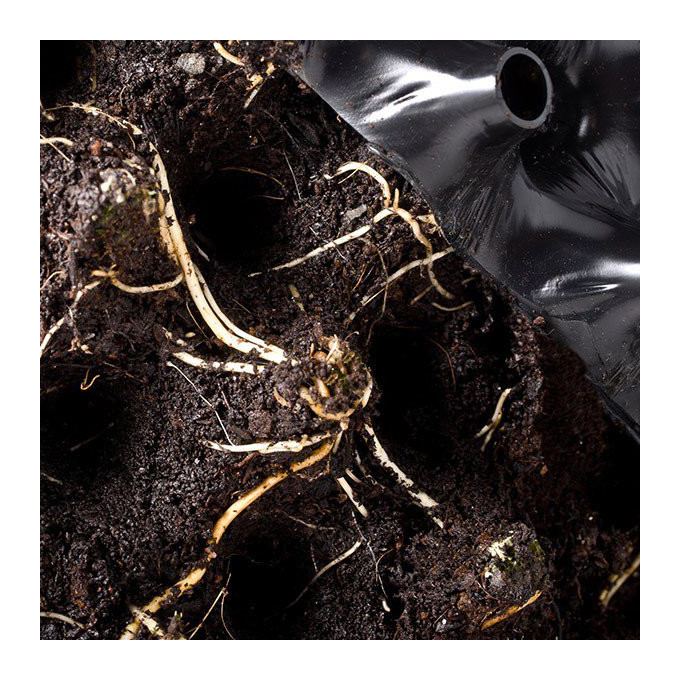

Air-Pot is one of the best systems for the development of the root system. Air-Pot revolutionizes container growing by producing a dense root system and eliminating spiral root growth. The shape of the pot guides each root into a hole where increased air in the soil dehydrates the tip, pruning it naturally and encouraging roots to emerge from the stem. As each new root follows the same path into the hole, the process repeats itself, and the plant quickly develops a mass of fibrous roots sticking out. This allows plants to take up more nutrients and water, which encourages faster growth. The result is healthier, prettier and more fertile plants.
The Air-Pot is a reusable, recyclable plastic container that actively improves the quality of the root system of plants. This revolutionary breakthrough in growing potted plants creates an extraordinary, non-spiralizing root system that is impossible to thrive in any other container available.
Made from recycled HDPE, the Air-Pot is circular in shape with a perforated profile, its texture is like an egg carton. It does not have a flat surface that facilitates the spiralization process for the roots.
Inward-pointing cones direct the root into the hole of outward-pointing cones, where the air density in the soil is too great, and therefore the apical cells at the very tip of the root become dehydrated. or are air-pruned. The plant response to this air pruning is to send more roots out to make up for the loss, leading to the generation of a dense, fibrous radial root system in a surprisingly short time.
Air-Pots can be made to any diameter in a variety of heights and can be used as planters with or without a base. It is characterized by an angular profile that offers a fantastic improvement that reduces costs and assembly time.
The real benefits of using Superoots Air-pots are:
- Eliminate root spiraling
- Reduce growing time in the nursery.
- Simplify production.
- Redouble - at least - the “useful life” of stocks.
- Drastically reduce losses.
- Guarantee superior performance in extreme weather conditions.
- The Air-pots are made of recycled HDPE.
1 Like