My leaves are turning yellow with strange bluish-purple spots. I did let the pot dry out a bit too much. I have started to water more often and a larger amount. I grow with a mix of organic and synthetic nutrients. I don’t feed as much of the synthetic nutrients, about half. I know at least one person will say something about it. The thing the leaves are on is the basement floor. Not the inside of the tent.
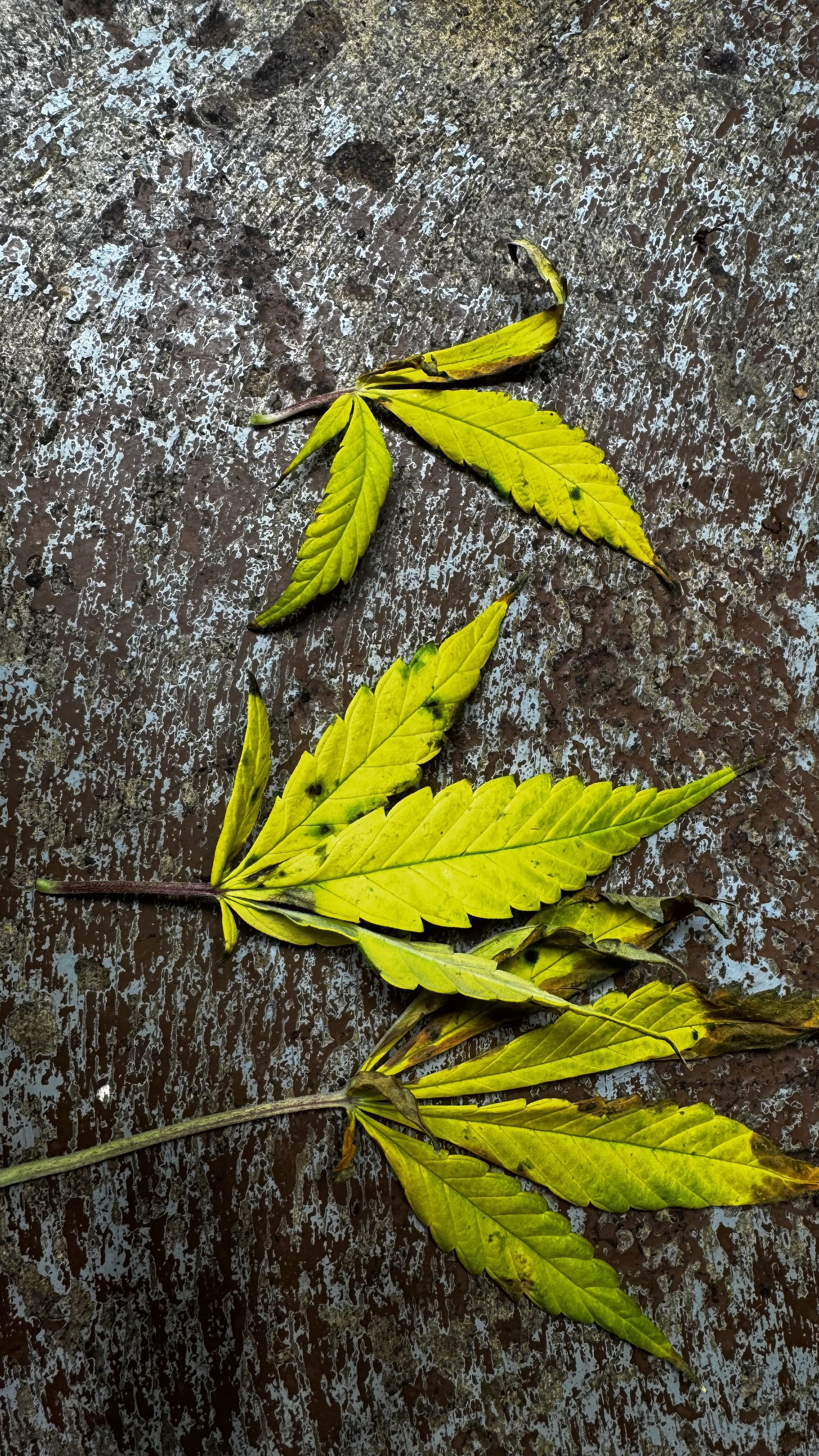
Looking closely at the photograph it looks like mold, I hope I’m wrong.
Are there fine hairs visible on the spots?
how old is it? if it’s old, it could be senescence accelerated by drought, I imagine the yellowing was already part of normal nitrogen mobilization and I wouldn’t worry too much about that, but the necrosis and the green patches that remained, I think they could just be dead leaves due to the acceleration of natural aging speeded up by drought, or is it showing you more problems?
Since you mention the basement floor right away: Are the pots sitting on the cold floor? Even inside the tent? Cannabis plants hate cold feet.
It would be interesting to know when you noticed it. Did it happen when you changed the watering schedule? If so, I would guess it’s a lockout.
Improper watering is often the main cause of deficiencies or lockouts.
Morning!
You’ve partly answered the problem yourself already.
@Demonrage75
The soil was too dry, and that explains the symptoms very accurately. The combination of
overly dry substrate and the mix of organic and synthetic fertilizers most likely led to salt buildup (nutrient burn) and disrupted soil biology—not mold.
Synthetic fertilizers consist of mineral salts. When the soil dries out too much, the salt concentration in the remaining water spikes drastically. This “burns” the fine root hairs and causes the brown, dried-out leaf tips and edges.
Due to the damaged roots and the altered balance in the substrate, the plant can no longer take up nutrients (like nitrogen). In response, it pulls mobile nutrients from the older leaves—turning them completely yellow.
Organic fertilizer requires microorganisms in the soil to become available to the plant. If the soil dries out completely, many of these microorganisms die off, and synthetic salts inhibit them even further.
Dry soil often repels water (becomes hydrophobic). First, the soil should be re-moistened thoroughly, sip by sip and slowly over 15–20 minutes, so that no dry spots remain in the pot.
Pause fertilizing briefly:
For the next 1–2 waterings, you should skip extra fertilizers entirely so the roots can recover.
Water more regularly:
In the future, water when the pot feels noticeably lighter, but before the soil gets bone-dry.
Once the soil is nicely moist again, introduce fresh microorganisms. Via compost tea, for instance.
Do those dark spots remain on the leaves!
The round, dark to black spots on the middle yellow leaf in the photo could indicate Septoria leaf spot (Yellow Leaf Spot). While it is a fungus, it’s not the typical mold that attacks buds—it usually develops from high humidity and a lack of air circulation around the lower leaves.
Trim off heavily spotted leaves cleanly to prevent any potential fungal spread and to improve air circulation.
Lower the humidity slightly if it is too high.
I hope I was able to help you a bit.
Greetings from Pflanzenpaul
I’ve always heard they go into a hibernation state unless it really gets dry then they die. I add new microbes every week. I use Advanced Nutrients Piranha, Tarantula, and Voodoo Juice plus Recharge that has all kinds of goodies in it.
Definitely not old enough for senescence.
No the pots don’t sit on the ground. They sit about 2-3 inches off the ground. The basement is heated and sits about 1-2 degrees cooler than the upstairs does.
Before, I was watering on Mondays and Fridays, with nutes on Fridays as well. Now I water only on Monday and Wednesday with nutes on Friday. I use 10-gallon pots so I’ll give them all a liter each in rounds. I start at one end of the room and work my way across the room and repeat that till they all have the water they need.